 Lyrith's Tower
How to Play Catan: Official Rules and FAQs
Welcome to our guide to learning how to play Catan. Here are all the rules explained step-by-step so you don't get confused with the board.
Catan Fact Sheet and Basic Information
Catan, formerly known as The Settlers of Catan, is a modern board game classic designed by Klaus Teuber and released in 1995 by KOSMOS, with distribution in Spain handled by Devir Iberia. Since its debut, when it received the prestigious Spiel des Jahres award, it has become a global benchmark.
The game is designed for 3 to 4 players, though you can expand it to 5 or 6 people by using its official expansion. Games have an estimated duration of between 60 and 120 minutes, and the minimum recommended age is 10 years and up. Its main mechanics combine resource management, trading, negotiation, placing a modular board, and controlled chance through dice rolls.
- Author: Klaus Teuber
- Spanish Publisher: Devir Iberia
- Players: 3 to 4 (expandable to 5-6)
- Duration: 60 to 120 minutes
- Minimum Age: 10 years and up
Game Objective and Setup
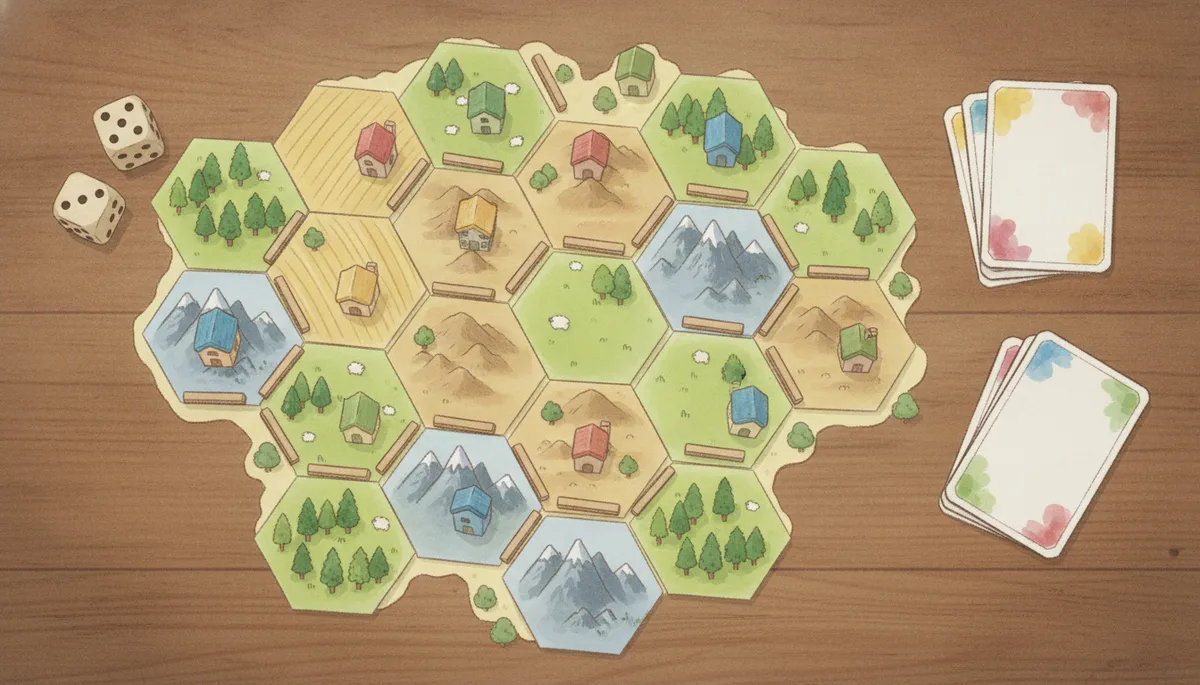
The main objective of Catan is to be the first player to reach or exceed 10 victory points during your own turn. To begin, you must assemble the modular board by connecting 6 sea frame pieces to enclose 19 randomly placed terrain hexes: 4 forest (wood), 4 pasture (wool), 4 field (grain), 3 hill (brick), 3 mountain (ore), and 1 desert.
18 circular number tokens from 2 to 12 are placed on these terrains, excluding 7, while the desert remains without a token. The numbers 6 and 8 are in red and larger due to their high statistical probability. Each player receives 15 roads, 5 settlements, and 4 cities in their color, plus a cost chart. In turn order, you place two settlements and two adjacent roads; the second settlement grants you your initial resources based on the surrounding terrains.
- Modular board with 19 hexes and number tokens
- 95 resource cards and 25 development cards
- Special award cards for longest road and largest army
- 15 roads, 5 settlements, and 4 cities per player
Turn Progression: Production, Trade, and Construction Phases
The first phase is dice rolling and production. You roll two six-sided dice, and the sum indicates which hexes produce resources. All players with an adjacent settlement receive one card of that resource, and those with a city receive two cards.
The second phase is trade. You can freely negotiate and exchange raw materials with other players, or engage in maritime trade with the bank. This trade can be generic, exchanging 4 identical cards for 1 of another type, at general ports for 3:1 if you have a building there, or at specific ports for 2:1 for the port's specific resource. The third phase is construction, where you spend resources to build as many times as you wish before passing the dice.
- Phase 1: Roll two dice and distribute resources
- Phase 2: Free trade with players or maritime trade with the bank
- Phase 3: Construction and purchases with available resources
Construction Costs
To expand your domains across the island, you need to consult the official construction cost chart and spend the exact materials required in each case.
Remember that each item has a fixed price in raw materials, and you can build as long as you have the necessary resources during your turn.
- Road: 1 brick and 1 wood
- Settlement: 1 brick, 1 wood, 1 wool, and 1 grain (grants 1 victory point)
- City: 3 ore and 2 grain (built by replacing a settlement and grants 2 victory points)
- Development Card: 1 ore, 1 grain, and 1 wool
The Robber, the Number 7, and Development Cards
If a 7 is rolled, the robber is activated. No terrain produces resources that turn, and all players with more than 7 resource cards must discard half, rounded down. Additionally, you move the black robber figure to another hex to block its production and steal one card at random from a rival with properties on that terrain.
You can also buy development cards, which are kept hidden in your hand. You can only play one card per turn, and never on the same turn you bought it, unless it's a victory point card that grants you the win. There are Knight cards to move the robber, Progress cards like Road Building, Year of Plenty, and Monopoly, and Victory Point cards.
- Robber: Activated by a 7 or a Knight card
- Mandatory discards if you have more than 7 cards in hand when a 7 is rolled
- Knights, progress, and victory points hidden in development cards
Special Awards for Longest Road and Largest Army
During the game, you can earn two special award cards that grant 2 victory points each and can change hands if your rivals surpass you.
The Longest Road is awarded to the first player who achieves an unbroken chain of at least 5 roads. If someone builds a longer road, they snatch the card and its points. The Largest Army is granted to the first player who plays 3 Knight cards, and it can also be taken away if an opponent plays more knights than you.
- Longest Road: Unbroken chain of 5 roads (2 points)
- Largest Army: Playing 3 Knight cards (2 points)
Frequently asked questions
Can you build a settlement next to another?
No. The distance rule applies, meaning there must always be at least one empty intersection separating settlements, regardless of ownership.
Can you play a development card right after buying it?
No, you must wait until the next turn, unless it is a victory point card that grants you immediate victory.
Can a rival's settlement block your trade route?
Yes. If an opponent builds a settlement in the middle of your chain, your route is broken and no longer counts towards the Longest Road from that point.
Can you win with hidden points on another player's turn?
No, victory must be declared obligatorily during your own turn upon reaching or exceeding 10 points.

«Put on your best settler boots and see if you're the first to shout victory in Catan, because the wood and brick won't gather themselves!»
View Meeplemancer on Google Play