 Lyrith's Tower
How to Play Wingspan: Step-by-Step Rules
Wingspan is a resource management and engine-building board game designed by Elizabeth Hargrave. Here, we explain all the step-by-step rules so you can start playing with confidence.
Game Objective and Main Components
In Wingspan, published in Spanish by Maldito Games and originally by Stonemaier Games, the objective is to be the player with the most victory points at the end of the game after 4 rounds.
To achieve victory, you must sum the points from played birds, your bonus cards, end-of-round goals, eggs on birds, accumulated food tokens, and cached cards. The game is designed for 1 to 5 players, with games lasting between 40 and 70 minutes and recommended for ages 10 and up.
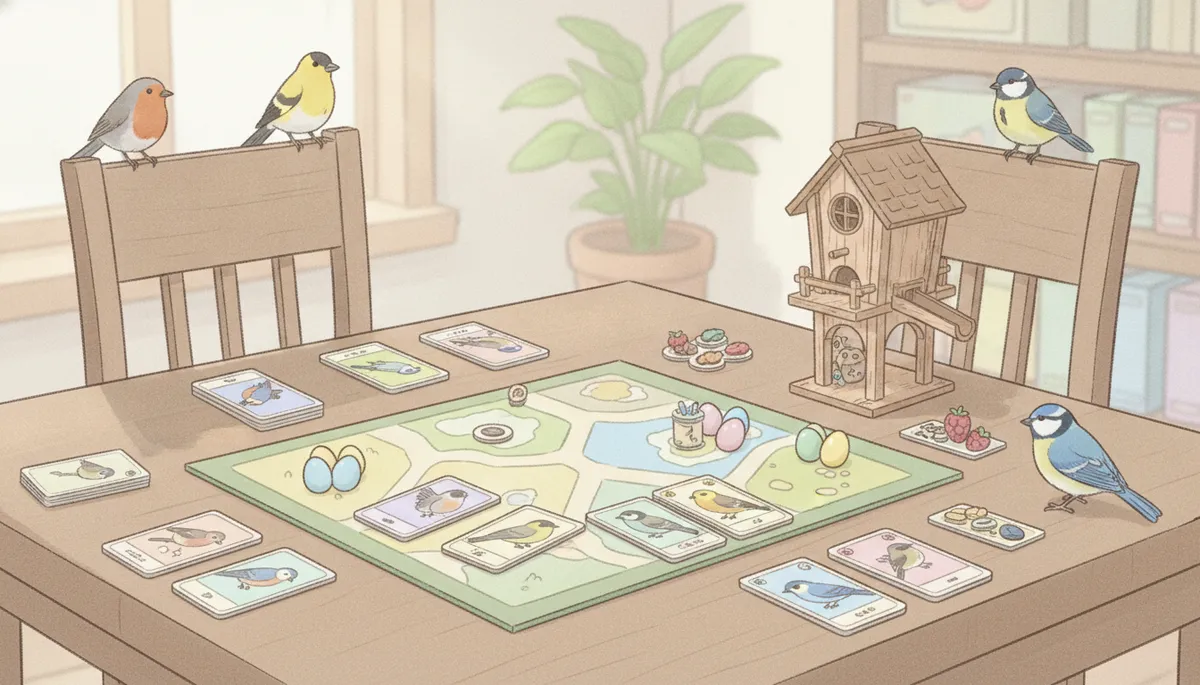
The box includes 170 bird cards, a dice tower or bird feeder, 5 wooden food dice, 75 colored egg miniatures, 5 player mats, 40 action cubes, goal tiles, food tokens like invertebrates, seeds, fish, fruit, and rodents, as well as bonus cards.
- Approximate playtime of 40 to 70 minutes
- Deck management, resource management, and engine-building mechanics
- Designed by Elizabeth Hargrave and released in 2019
Initial Game Setup
Each player receives an individual player mat and 8 action cubes of the same color. Additionally, deal each participant 5 bird cards, 5 food tokens (one of each type), and 2 bonus cards, from which you must choose one and discard the other.
Regarding initial costs, you can keep whichever cards and food you wish, but for each bird card you decide to keep at the start, you must pay one food token from your initial supply.
The Four Rounds and Round Objectives
The game is played over exactly 4 rounds. Each round has a decreasing number of action cubes per player: 8 in the first round, 7 in the second, 6 in the third, and 5 in the fourth.
At the end of each round, the goal board is evaluated. This board can be played in competitive or standard mode with green faces, or in novice or cumulative mode with blue faces. Points are awarded based on players' position or achievement of the stated goal. After this, a scoring action cube is removed, and the first player token is passed.
The Four Action Types and Habitats
On your turn, place one of your available action cubes in one of the four rows on your player mat to perform that action. Except for 'play a bird,' executing an action also activates the powers of birds already placed in that same habitat, from right to left.
The first action is to play a bird, which allows you to place a card from your hand into its corresponding habitat: forest, grassland, or wetland. You must pay the indicated food cost, respect the column where the first birds in the row are free in eggs, and subsequent ones cost one or two eggs already laid, and meet the habitat requirement.
The second action is to gain food in the forest habitat, taking tokens from the supply based on the results of the dice available in the tower or feeder. If, when you go to take food, the feeder is empty or all dice show the same face, you can re-roll all dice before choosing.
The third action is to lay eggs in the grassland habitat, placing the indicated number of miniatures on your bird cards that have storage capacity. The fourth action is to draw bird cards in the wetland habitat, taking cards from the deck or from the face-up options displayed on the tray.
Bird Powers and Final Scoring
Bird powers are classified according to when they are activated, indicated by background colors in the card text. Brown powers, or 'when activated,' trigger when you use the habitat action from right to left. White powers, or 'when played,' execute only once when the bird is placed. Pink powers, or 'between turns,' activate outside your turn by taking advantage of other players' actions under specific conditions.
At the end of the fourth round, final scoring is calculated by summing the points printed on each played bird card, fulfilled bonuses, end-of-round goals, and one point for each egg on any bird card, food token accumulated on cards, and cached card under birds.
In case of a tie in final scores, the player with more leftover food tokens wins. If the tie persists, the victory is shared.
- Brown powers to activate when using a habitat
- White powers to use when playing a card
- Pink powers to take advantage of other players' turns
- Tie-breaker based on leftover food tokens
Frequently asked questions
Can bird spots in habitats be cleared?
No. Once you place a bird in a slot on your player mat, it stays there for the entire game. Actions only serve to add new birds to the free spaces from left to right.
When are the bird cards in the common tray replenished?
At the end of your turn, not immediately: if you take a face-up card, the space remains empty until you finish.
What if I don't have enough eggs to pay for a bird?
You cannot play it in that column. The first column is free; the second and third cost 1 egg, and the fourth and fifth cost 2. You will first need to lay eggs using the grassland action.
«I hope this guide helps you fill your aviary with feathers and points! See you in the next game around Serranen Village!»
View Meeplemancer on Google Play