 Lyrith's Tower
How to Play Carcassonne: Rules and Scoring
Carcassonne is one of the most beloved modern board games. If you want to learn the rules of Carcassonne, its scoring, and how to place followers, we'll explain everything here step-by-step.
Game Basics and Components
Created by Klaus-Jürgen Wrede and originally published by Hans im Glück in 2000, Carcassonne has become an essential classic. In Spain, it is usually published by Devir. It's a game designed for 2 to 5 players, recommended for ages 7 or 8 and up, with games lasting between 30 and 45 minutes. In 2001, it won the prestigious Spiel des Jahres award.
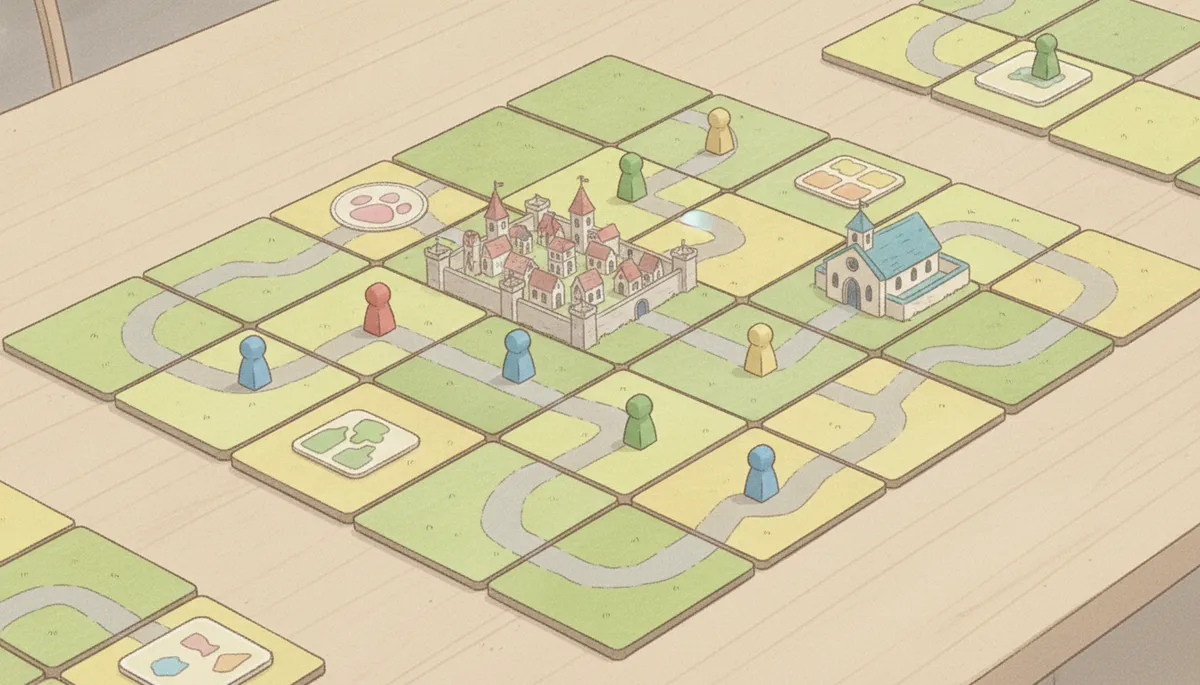
Inside the box, you'll find 72 land tiles with roads, cities, and monasteries, including a starting tile with a dark back. It also includes 40 wooden figures or followers, known as meeples, divided into 5 colors: black, blue, red, green, and yellow. Each player chooses a color, sets aside 1 figure to track their score, and keeps 7 followers to play with.
- 72 land tiles in total
- 40 wooden followers in 5 different colors
- A starting tile with a dark back
- Score tracker to keep track of game points
Game Setup
Before you begin, place the starting tile with the dark back in the center of the table. Shuffle the rest of the land tiles and place them face down in several accessible stacks for all players.
Place the score tracker to one side of the table and put each player's marker on the zero space. Everything is ready for the first player to start drawing and placing tiles.
- Place the starting tile in the center
- Shuffle the remaining tiles into face-down stacks
- Place the score tracker on the zero space
Placement Rules on Your Turn
First, draw a tile from the stack. Second, place it on the table adjacent to the tiles already in play.
You must follow a strict matching rule: the touching edges must necessarily match in their terrain type. A road must connect to another road, a city to another city, and a field to a field. You cannot place a city directly adjacent to a field.
After placing the tile, you can decide whether to place a follower from your personal supply onto the newly played structure, whether it's a road, a city, a monastery, or a field. You can only do this if that feature or structure is not already occupied by another follower.
- Draw a tile from the stack
- Place it respecting terrain types
- Optionally, place a follower on the played tile
Types of Features and Follower Placement
Depending on where you decide to place your meeple, it will be given a name and specific functions within the game.
Bandits are followers placed lying down on a segment of road. Knights stand within the walled enclosure of a city. Monks stand upright directly on the monastery depicted on the tile. Finally, farmers or peasants lie down on an area of meadow or field.
Watch out: farmers stay on the board for the entire game and are never returned to the player's hand.
- Roads: followers go lying down as bandits
- Cities: knights are placed standing up
- Monasteries: monks are placed standing up
- Fields: farmers lie down on the meadow
When and How to Score During the Game
Features are scored immediately as soon as they are completely closed or finished. A road is completed when its two ends terminate at intersections, cities, or monasteries. A city is completed when it is fully surrounded by walls with no open gaps. A monastery is completed when it is surrounded on all eight sides by adjacent tiles, forming a three-by-three block.
Once a completed feature is scored, all followers participating in it are returned to their owners' hands to be reused. If a completed feature contains followers from multiple players due to later connections, the player with the most followers takes all the points. In case of a tie, all tied players receive the full score.
- Completed roads: 1 point per tile
- Completed cities: 2 points per tile and 2 points per shield
- Completed monasteries: 9 points total
- Meeple recovery for later turns
Final Scoring and Farmer Evaluation
The game ends the moment the last tile from the draw pile is placed and no more can be drawn. At that moment, the final scoring of any incomplete structures takes place.
Incomplete cities award 1 point per tile and 1 point per shield. Incomplete roads give 1 point per tile. Incomplete monasteries score 1 point for the monastery plus 1 point for each adjacent tile surrounding it.
Finally, the farmers in the fields are evaluated. Each field supplies the complete cities that directly border it. For each distinct complete city, the player with the majority of farmers in that field earns 3 points, regardless of field size. Incomplete cities score no points. The player who accumulates the highest total score at the end wins the game.
- Incomplete cities: 1 point per tile and shield
- Incomplete roads: 1 point per tile
- Incomplete monasteries: 1 point for the monastery and adjacent tiles
- Farmers: 3 points for each supplied complete city
Frequently asked questions
Can I place a follower on a feature that is already occupied?
No. If a road or city already has a meeple, no player can directly place another one on it that turn. You can only connect them indirectly with later tiles.
What happens if the tile I draw doesn't fit anywhere?
It's very rare, but if it happens, that tile is set aside (returned to the box), and you draw another one.
Are farmers returned during the game?
No. Farmers placed on fields are blocked there for the entire game and are never returned to your hand.

«Put on your knight's helmet, and I'll see you in the village to play some games of Carcassonne!»
View Meeplemancer on Google Play